How AI Can Help Homeowners Visualize Renovation Ideas Before Spending Money

This article was written by a guest contributor.
Renovating a home is exciting, but it can also feel like a leap of faith. Most homeowners do not struggle with finding inspiration. They can save beautiful kitchens on Pinterest, scroll through living room makeovers on Instagram, or visit showrooms full of paint, flooring, lighting, and furniture. The harder part is knowing whether those ideas will actually work in their own home.
A sofa that looks perfect in a staged photo might feel too large in a real living room. A warm beige paint color might look gray in a north-facing bedroom. A cabinet finish that feels timeless in a showroom might clash with existing floors. These decisions are not small when they involve real money, delivery times, contractors, and installation costs.
This is where AI interior design tools can be genuinely helpful. They are not here to replace taste, planning, or professional advice. Instead, they give homeowners something that used to be difficult to access: a quick visual preview of how a renovation idea might look before anything is purchased.
Why Visualization Matters Before Renovating
Many renovation mistakes happen because people make decisions from imagination alone. They see a tile, a chair, or a paint sample in isolation and hope it will work once everything is together. But rooms are made from relationships: color, scale, natural light, layout, materials, and personal habits all affect the final result.
For example, a darker wall color might make a bedroom feel cozy, but it can also make a small room feel heavy. Removing upper cabinets can make a kitchen look modern, but it may not suit a household that needs more storage. A beautiful accent chair may not be practical for a family with pets or young children.
AI does not make those decisions for the homeowner, but it can make the options easier to compare. Instead of asking, ‘Will this look good?’ homeowners can create a rough visual direction and ask a better question: ‘Does this feel right for the way I want to live?’

Testing Styles Without Committing
One of the most useful parts of AI design is the ability to test different styles quickly. A homeowner may think they want a minimalist bedroom, then realize through visuals that the room feels too empty. Someone else may love the idea of a dark, moody kitchen but discover that a softer organic modern look feels more comfortable.
This process can save time because it helps narrow the direction early. Before ordering furniture or speaking with contractors, homeowners can explore several paths: Scandinavian, modern farmhouse, Japandi, traditional, coastal, industrial, luxury, or something more personal. Seeing the same room in different styles can make the final choice feel less random.
Tools such as DecorAI AI Interior Design make this process approachable because users can start with a real photo of their own room. That matters. A generic inspiration image may be beautiful, but a design preview based on the actual space feels much more useful for planning.
Avoiding Expensive Guesswork
Renovation decisions often become expensive because one choice leads to another. If a paint color feels wrong, the curtains may also feel wrong. If the new flooring does not match the cabinets, the entire room can feel unfinished. If the sofa is too large, the layout becomes uncomfortable even if the piece itself is beautiful.
AI visualization can help homeowners catch some of these issues earlier. It can show whether a room might benefit from lighter furniture, warmer lighting, more contrast, different wall colors, or a better layout. It can also help people decide what not to do, which is just as valuable.
This is especially helpful for people who are renovating gradually. Not every homeowner changes everything at once. Many people update one room in stages: paint first, then lighting, then furniture, then decor. AI can help them see whether each step supports the overall direction instead of creating a room that feels patched together.
Making Conversations With Designers and Contractors Easier
Another practical benefit is communication. Homeowners often know what they like, but explaining it clearly can be difficult. Words like ‘cozy,’ ‘modern,’ ‘warm,’ or ‘elegant’ can mean different things to different people. A visual reference gives everyone a clearer starting point.
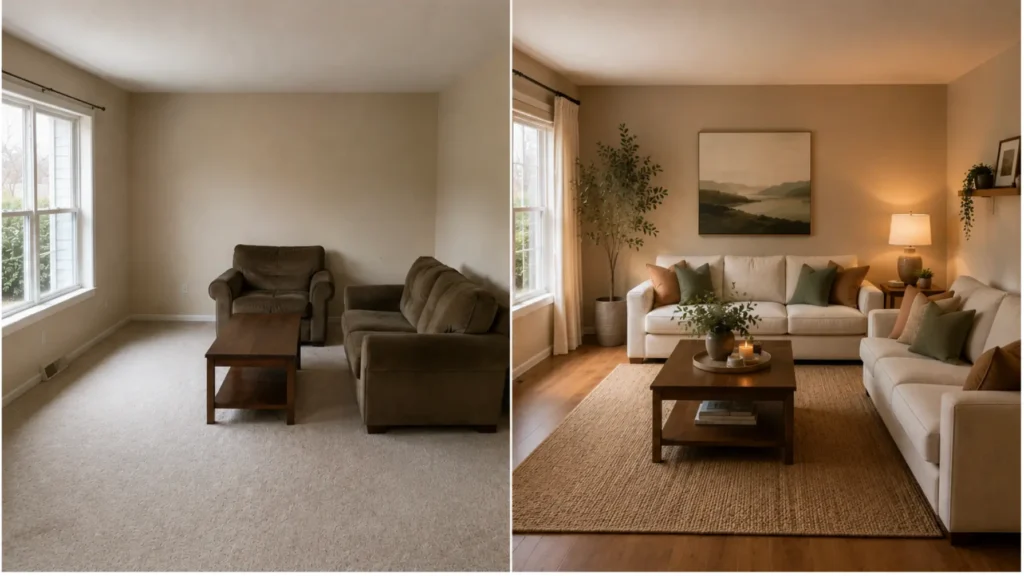
If a homeowner is working with an interior designer, AI images can help express preferences at the beginning of the process. If they are speaking with a contractor, the visuals can clarify the mood, material direction, or layout goals. The AI concept does not need to be a final plan; it can simply be a starting point.
Where AI Still Needs Human Judgment
Of course, AI has limits. It may create beautiful ideas that are not always practical, properly scaled, or technically possible. It may suggest furniture placement that looks good in an image but does not account for walking space, outlets, door swings, building codes, budget, or real product availability.
That is why AI should be used as an inspiration and visualization tool, not as the only decision-maker. Homeowners still need to measure, compare materials in real light, check product dimensions, and think about how the room will function day to day. For larger renovations, professional guidance is still important.
The real value of AI is that it helps people move from uncertainty to clarity. A homeowner may not follow the AI result exactly, but they can use it to understand what they like, what they dislike, and which direction feels worth exploring.
A Smarter First Step Before Spending Money
Renovation will always involve some level of decision-making and risk. But homeowners no longer have to rely only on imagination, mood boards, or showroom displays. AI gives them a way to preview ideas earlier, test styles faster, and approach expensive choices with more confidence.
Whether someone is planning a bedroom refresh, a kitchen update, a bathroom redesign, or a full home makeover, visualization can make the process feel less overwhelming. Platforms like DecorAI are useful because they make that first step simple: upload a room photo, explore design directions, and use the results as a clearer starting point before spending real money.
For homeowners, that may be the biggest benefit of all. AI does not need to create the perfect final room. It simply needs to help people see possibilities more clearly, avoid obvious mistakes, and make renovation decisions with a little more confidence.
Click Here To Shop My Favourite Home Goods
Let’s design your space together, virtually.