Designer Shares: How To Create A Cohesive Home
It’s become clear to me that many people struggle with creating a cohesive home — and if you’re reading this post, you might be one of them.
You may have found yourself asking AI questions such as:
- “How do I mix interior design styles?
- “How do I make sure all the furniture I buy works together?”
- “How do I create a home that feels cohesive?”
- “Help, what do I do?! I just bought all this furniture that doesn’t work together.”
As a designer, creating a cohesive and harmonious home is always my top priority. But I’ll be honest — it’s not always an easy task. A home has many layers, and it’s natural to feel drawn to different styles, furniture pieces, and aesthetics along the way. So, let me guide you on how you can create a cohesive and harmonious home.

AVOID COSTLY (AND UGLY) DESIGN MISTAKES

How To Mix Interior Design Styles

People often feel stuck between different interior design styles — and that’s completely okay. In fact, following one design style to a T isn’t something I typically recommend. If you find yourself drawn to more than one style, that’s great! But the challenge is in mixing those styles in a way that feels intentional and cohesive.
So, where do you start?
Read: Interior Design Styles Simplified: What’s Your Style?
Can These Styles Actually Work Together?
As a designer, part of me wants to believe that anything can work in a space with the right styling — and while I do believe that to an extent, the reality is that some styles naturally pair better than others.
Some of my favourite combinations include:
- Mid-Century Modern + Vintage
- Art Deco + Contemporary
- Glam + Traditional
These styles tend to share overlapping elements — whether it’s materiality, scale, or silhouette — which helps them blend more seamlessly.
On the flip side, some styles are more difficult to pair, especially when you’re trying to mix three or more. (We’ll get into that in a bit.) For example, Coastal and Art Deco would be tough to combine, as they sit on opposite ends of the aesthetic spectrum.
How to Know If Two Styles Can Work Together

Start by asking yourself:
“How eclectic am I willing to go?”
If your taste leans eclectic, then great — you have more freedom to experiment with contrast, colour, and form. Eclectic design thrives on the unexpected.
But if you prefer a more uniform or balanced look, then it’s important to make sure the styles you’re mixing share some common ground. You can do this by identifying overlaps in:
- Colour palettes
- Materials or textures
- Silhouettes or shapes
- Patterns and detailing
For example, Minimalism and Scandinavian styles often pair well because they both value simplicity, clean lines, and neutral tones. Meanwhile, Farmhouse and Industrial can work thanks to shared materials like wood and metal.
But try pairing Boho with Brutalism, or Coastal with Baroque — and you may find it harder to create harmony.
The Method Of Mixing Styles That Ensures a Cohesive Home
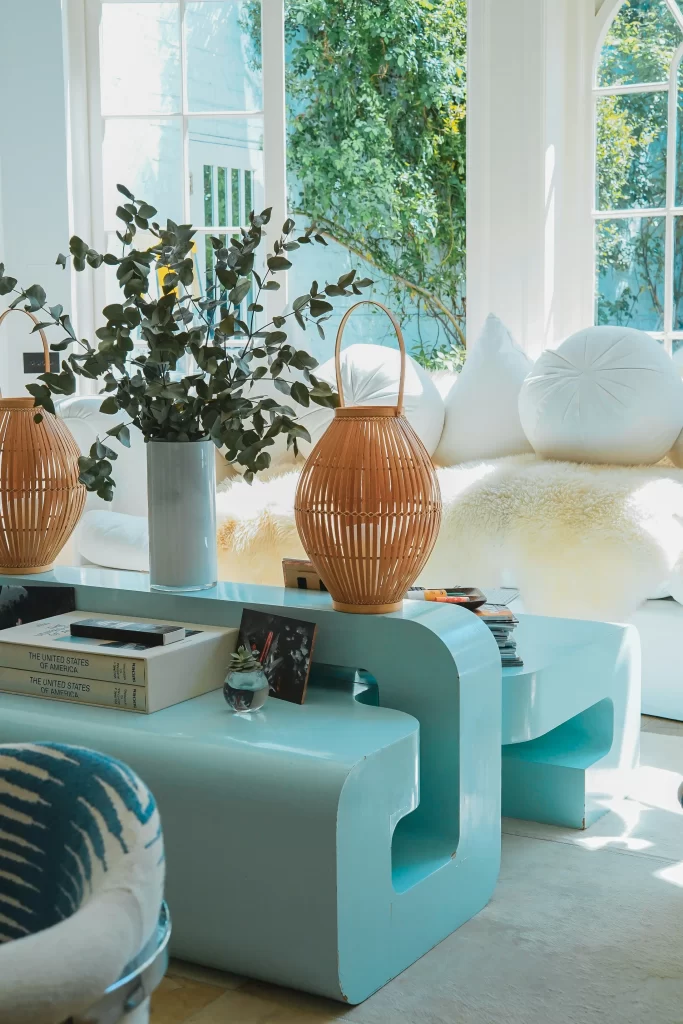
So, you’ve chosen your interior design styles — now what?
You might be thinking: “How do I create a cohesive outcome? Which pieces should be in Style X, and which in Style Y?”
Let me break it down using a real client as an example.
She came to me wanting help figuring out her design style. And while I’m not a big fan of labels, I do like to understand what styles someone naturally gravitates toward — because that helps me design a space that feels authentic to them.
After analyzing her home and preferences, I concluded that she was drawn to Contemporary, Mid-Century Modern (MCM), and Glam, with a touch of Vintage.
Amazing — right up my alley!
So how did I make all these styles work together? And how can you do the same?
Identify Your Style Hierarchy
Start by figuring out which interior design style resonates the most with you — this will be your primary style. For this example, let’s say it’s MCM.
Next, choose your secondary style — maybe that’s Vintage.
If there’s a third style you want to incorporate, identify that too (e.g. Glam). Just keep in mind that the more styles you mix, the more intentional you need to be.
The Style Ratio (Yes, a Little Math 😅)

Once you’ve picked your styles, use the Style Ratio Rule to guide how you mix them in your space:
- Two styles? Use a 70/30 split.
→ Let’s say 70% of your space reflects MCM and 30% Vintage. That means your larger, foundational pieces (like the sofa, bed frame, or dining table) should be MCM, while your accents (lighting, decor, side chairs, etc.) can lean Vintage. - Three styles? Use a 60/20/20 split or 60/30/10.
→ For example, 60% MCM, 20% Glam, 20% Vintage. MCM remains the base, while Glam and Vintage are used as accents in materials, lighting, textiles, or statement pieces.
The key is to let one style lead the way, while the other styles are layered in as supporting elements. This helps keep the space cohesive and avoids it feeling chaotic or mismatched.
Now, are these hard rules? Not at all. But if you’re a DIYer or just starting out, this is the most practical approach I can recommend for mixing styles with confidence.
The Key To Creating a Cohesive Home

Now that we’ve broken down how to mix styles — one of the most common concerns when creating a cohesive home — I want to dive deeper into what actually makes a home cohesive, from a designer’s perspective.
Think of your home like a storybook. It should tell one overarching story — yes, with different chapters and characters (aka rooms and design elements) — but there should still be a clear plot line that ties everything together.
Now, I get that might sound a bit metaphorical, so let me explain more practically.
What Actually Creates Cohesion in a Home?
One of the best ways to create cohesion is through common grounding elements. These are things that repeat throughout the home and visually link spaces together. Examples include:
- The same flooring (like hardwood or tile)
- Consistent trim or door frame details
- Matching or complementary hardware finishes (e.g., black or brass)
- A repeating colour palette across rooms
This doesn’t mean everything has to be matchy-matchy — not at all. But having intentional consistency in these foundational elements gives your home a baseline of harmony. It allows your style choices to feel fluid, rather than disjointed.
Mixing Styles Within the Same Home or Room
Remember what I said earlier — styles don’t need to be identical to work well together, but they do need to be complementary. Whether you’re mixing styles within one space, or across different rooms, the goal is to create visual flow.
Cohesion isn’t about making everything the same — it’s about creating a rhythm that feels connected.
Tip: Use “Easter Eggs” to Create a Cohesive Home
Let’s say you want to do something totally different in one room — for example, a dark and moody office — while the rest of your home is light and airy. That contrast can absolutely work, but try to add in a few “Easter eggs” that nod back to the overall design story.
Some ways to do that:
- Bring in a repeating pattern or texture from another space
- Echo a colour used elsewhere in the house
- Repeat architectural details like wainscoting, ceiling moulding, or panelling
- Use the same materials in a new way (e.g., marble or wood tones)
These subtle connections help your home feel intentional and well-thought-out, even when styles shift slightly between rooms.
It’s not about matching — it’s about being complementary, and using anchoring elements to bring everything together. When you walk through your home, each space should feel unique, but not like it belongs in a completely different house.
So, in short, here’s how to create a cohesive home:
- Understand your interior design style — it might be a unique mix of a few! Learn how to properly blend them.
- Establish common elements throughout the home (like flooring, hardware, trim, or colour palette) to tie everything together.
- Be intentional with your purchases and design decisions — each piece should support the overall vision.
Still feeling stuck? No worries — that’s what I’m here for. Let’s create a space that feels connected, curated, and totally you.
Click Here To Shop My Favourite Home Goods
Let’s design your space together, virtually.