How To Achieve Contemporary Interior Design In Your Home
As a designer, you’d think I would have my own interior design style nailed down perfectly. However, that’s not the case. If I had to describe my style, I’d probably start with the word contemporary, followed by eclectic and even a bit of minimal-maximalism. Now, if you’re not a designer, that might sound a little confusing — and that’s okay. This post isn’t about defining my personal style. Instead, it’s all about contemporary interior design: what it actually means, and how you can achieve it in your own space.
AVOID COSTLY (AND UGLY) DESIGN MISTAKES
What Is Contemporary Interior Design?

Contemporary interior design, simply put, is the design of the moment.
Now, you might be thinking: “Okay, so contemporary just means following all the latest interior design trends?” Well, that’s one way to look at it — but not quite the whole picture.
Contemporary design isn’t necessarily about chasing every trend (or fad). Instead, I like to think of it as creating impactful spaces that feel current, stylish, and a little bit edgy — spaces that have a sense of youth and freshness without being tied to just one trend cycle.
The Elements Of Contemporary Interior Design

Let’s break down the elements of contemporary interior design.
1. Trends
As mentioned, contemporary design is evolving with the trend cycles. Now, keep in mind: trends tend to stick around for about 10 years or so, while fads come in and out quickly. So don’t think of contemporary design as something that is not maintainable or sustainable. It’s more so a reflection of what’s in, what’s hot, what the cool girls are putting in their homes.
So, currently, what are the hot trends? I’d say bold patterns, organic shapes, playful touches, and dramatic statement art.
2. Minimalism
Now, minimalism can be classified as an interior design style in and of itself, but don’t get confused here. Decorating minimally is part of the contemporary style because, with contemporary interiors, the pieces speak for themselves.
For example: the shape of the sofa might be really interesting, therefore it doesn’t need much else to make it stand out. The rug might have a really lovely texture, therefore there’s no need for clutter to take away from the space.
So there’s an element of minimalism in contemporary design, in the sense that there are a lot of statement pieces that eliminate the need for a ton of supporting pieces.
And personally, this is what I like about contemporary design. I personally like a maximal style, however, I don’t like living in a maximal space (cleaning nightmare). So I’d rather have fewer things, but make sure the pieces I do have incorporated into the space are bold, making either a soft or loud statement — whatever the room requires.
3. Bold Accents
Contemporary interiors often have artwork that is very bold and captivating. These art pieces are often talking points, and in general, this style has a way of including bold accents into the space.
Now, as I mentioned, this could be brought in more subtly, like with the shape of a sofa, or more boldly with a patterned accent chair. There’s a balance and play here — interior design styles are a spectrum. Keep that in mind.
So contemporary styles could lean more bold, or more subtle, but always with accents built in.
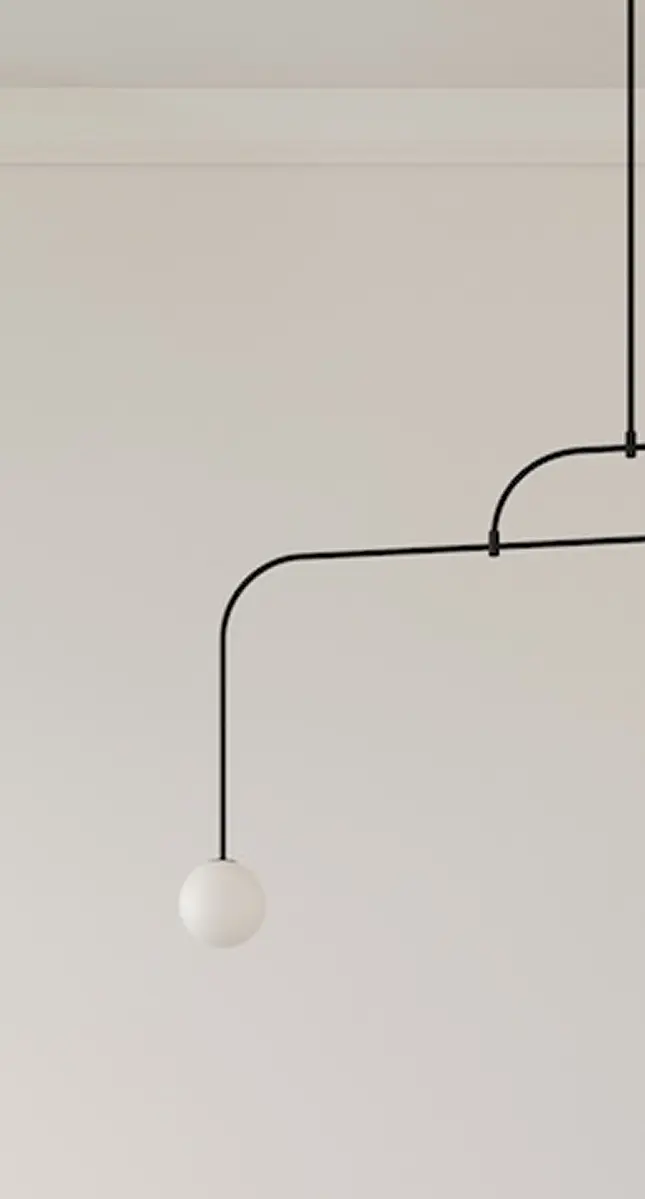
A bold accent can be introduced through a large lighting fixture, an interesting rug, or even a cool mirror. Tons of ways to bring this in.
4. Mix of Materials
Contemporary style isn’t about being uniform or overly matchy. In fact, matching is not something that is seen in contemporary interior style. Matching is too predictable and doesn’t allow for the layering we see in contemporary design.
Often, you’ll see different metal finishes, different wood finishes, and different shapes introduced. Don’t think “chaotic mess” — these elements are very thought out and work together, just not in a matchy-matchy way.
5. Clean and Curved Lines
One of the hallmarks of contemporary interior design is the use of clean and curved lines. Oftentimes, things are not overly ornate, but instead you’ll see bold, curved lines and a play with organic shapes.
So think less frills, and more curves, arches, and playful forms.
Architectural Details That Make a Home Contemporary

If you are starting your home design from scratch and want a contemporary foundation to build on, here are architectural details that will help you achieve the right look:
- Tall Baseboards With Minimal Detail
Tall, minimal baseboards truly give off the contemporary vibe. I love this detail in any space, especially when you’re trying to achieve this design style. - Tall Ceilings
Tall ceilings instantly create a contemporary vibe. You see it in almost every contemporary interior — tall ceilings. And I mean, who doesn’t love tall ceilings? - Open Floor Plan
Open floor plans are a big thing when it comes to contemporary interiors. Contemporary interiors often feel expansive, comfortable, and made for people to gather and share ideas. Consider opening up your floor plan to create that contemporary feel. - Large Windows
Large windows are often seen in contemporary homes, sometimes even with black trim (I love the high contrast). Windows are treated as works of art themselves, so the bigger and more windows, the better. - Arches
Arches are often seen in contemporary homes because, as I mentioned, curves and organic shapes are in for this style. So consider softening your edges.
Modern Vs Contemporary Interior Design
The words modern and contemporary get thrown around a lot in the interior design world — and I get it. If you’re not a designer, chances are you’re not an expert in design styles (and that’s totally expected). Even as a designer, I’ve had to simplify the way I talk with clients, often referring to styles in the way they would.
But if we want to get technical — and we should — it’s important to distinguish the difference between modern and contemporary interior design. So, let’s break it down.
Modern Design
- Time period: Refers to a specific era (early–mid 20th century, roughly 1920s–1950s).
- Philosophy: Rooted in modernist principles: simplicity, function over form, no ornamentation.
- Look/feel: Clean lines, natural materials (wood, leather, linen), lots of neutral tones with pops of primary colour.
- Vibe: Warm minimalism. Think mid-century modern furniture like Eames chairs, Noguchi tables, low-slung teak sofas.
Contemporary Design
- Time period: Refers to the current moment — what’s trending right now. (It changes as design evolves).
- Philosophy: A blend — borrows elements from modern, minimalism, Scandinavian, even industrial, depending on what’s in.
- Look/feel: Clean but more flexible — curves, organic shapes, mixed materials, bold accents.
- Vibe: Fresh, “of the moment.” What feels youthful, stylish, and now.
Contemporary Interior Design Style 101

So, there was my breakdown of the elements of the contemporary interior design style — both the furnishings and the architectural details that can set the tone.
In short, contemporary style is a style that follows the trends, adapts to shifts in interior design, embraces minimalism, but isn’t afraid to make an impact.
Personally, I love this style because of the organic shapes and curves, along with contemporary art. It’s truly a favourite combo of mine.
Click Here To Shop My Favourite Home Goods
Let’s design your space together, virtually.